Research through Design · Furniture
Cobogó Table
ROLE
Designer & Researcher
EXPERTISE
Furniture & Material Design
YEAR
2026
Glossy Concrete Without Polishing
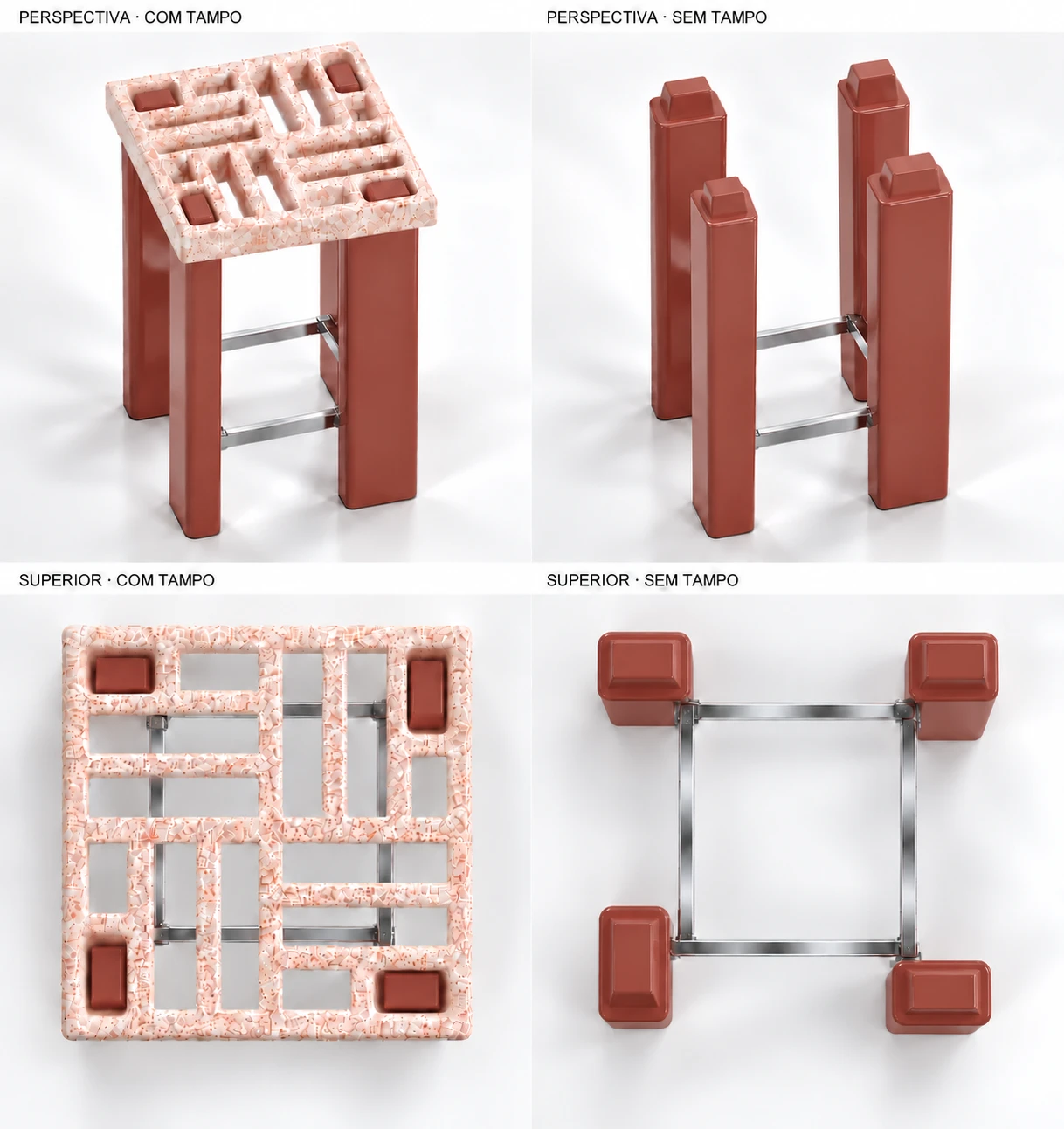
The Cobogó Table translates the cobogó (the perforated breeze block created in Pernambuco in 1929 and later a symbol of Brazilian modernist architecture) into a side table: a terrazzo cobogó tabletop resting on four smooth, pigmented concrete legs. While testing small pigmented samples for the piece, I noticed something unexpected. Samples cast directly against smooth polymer molds, without any release agent, came out with a mirror-like surface. That observation turned the project into a Research through Design inquiry into the mold–material interface, and into a way of getting a glossy concrete finish without mechanical polishing.
Challenges
Polishing concrete takes sequential grinding from about 50 up to 3,000 grit, plus specialized tools and hours of labor
The cobogó’s perforations multiply narrow internal faces that are slow and risky to sand
Aggressive abrasives remove material fast but chip the edges around the openings
Release agents, standard in precast practice, dulled the reflective as-cast finish
A recipe that works in small samples doesn’t automatically scale to a full-size mold
Wet mixtures misrepresent their final color, so pigment has to be judged after curing
High Level Goals
Translate the cobogó from an architectural element into a domestic object.
Achieve a mirror-like concrete finish straight out of the mold, without polishing.
Turn surprises from making into documented, transferable design knowledge.
Influences
the year the cobogó was created in Pernambuco, Brazil. It later became a symbol of modernist architecture, with roots in the Arab-influenced muxarabi.
leg castings, each treated as a diagnostic prototype that tested a single question about the mold–material interface.


of post-casting sanding avoided per leg compared with conventional polishing. The work moved to liner preparation instead.
in materials per leg with the MDF–PET mold, against roughly R$85–140 for a conventional grind-and-polish approach.
Process Overview
The project followed a first-person Research through Design approach, treating material exploration, fabrication and reflection on unexpected outcomes as sources of design knowledge. Each phase shaped the next, and every formulation, mold condition, failure and outcome was documented in photos and notes.
Material Tinkering
Open-ended exploration with small cast samples, comparing matrix composition, filler ratio, water content and pigment combinations. This is where the unexpected gloss first appeared.
Controlled Comparisons
Isolated the release agent as a variable: using a new mold, a sample cast with an ultrathin layer of mineral oil lost gloss next to one cast with no release agent at all.
Full-Scale Verification
Cast the 38 × 38 cm terrazzo tabletop and 19 × 19 cm intermediate cobogós to test whether small-scale findings held under real geometry, scale and casting labor.
Diagnostic Casting
Fabricated the legs iteratively in a hybrid MDF–PET mold, using each cast to answer one question, and measured gloss with a custom camera-based pipeline to choose the final mix.
Gloss was never a planned research question. It surfaced during a color test, and only became a finding once I tested it against alternative explanations (pigment, laitance, confinement) and let it redirect the rest of the project.

An Unexpected Gloss
While comparing pigments in a glossy PET mold, two samples came out far more reflective than the rest, and they were the only cavities that hadn’t received a release agent. Cutting sample B7 in half revealed a reflective outer skin over a matte interior: the gloss wasn’t in the material, it formed where the mixture met the mold.
A Hybrid MDF–PET Mold
To bring the finish to the table legs, I split the mold’s roles: a disassemblable MDF structure provides rigidity, while a thin PET liner forms the surface. Switching from separate panels to one continuous liner reduced seams, and unscrewing the mold instead of pulling it made demolding easy, with no release agent needed.


Mirror-Like, Straight From the Mold
On the first legs, mixture that leaked behind the liner came out even glossier, pointing to sustained contact between mixture and PET. A denser, hand-kneaded mix (BlokGraute Pro+ at w/c 0.24) achieved that contact across the whole surface. From the fourth cast on, every leg demolded with a uniform, mirror-like finish, and four of them became the final table.
Outcome
The finished side table combines four glossy, deep-pink legs with a sanded terrazzo tabletop made with reclaimed quartz scraps, making two contrasting finishing strategies visible in a single object. The legs keep the reflective skin they were cast with; the tabletop removes its skin to reveal the aggregate. A glass top keeps the perforated cobogó visible underneath.
The Mold as a Finishing Tool
Choose the material in direct contact with the mixture for the finish it transfers, and separate structure from surface: inexpensive MDF holds the shape, while a thin PET liner delivers the gloss.
Redistributing Finishing Labor
The MDF–PET mold doesn’t eliminate finishing work. It moves it earlier, from sanding cured concrete to preparing the liner, where mistakes are still recoverable.
Gloss Quantification
A low-cost Python and OpenCV pipeline separates specular highlights from base color in smartphone photos, making it possible to compare water/cement ratios and superplasticizers before committing to a full-scale cast.
Next Steps
The findings point to fabrication tools that treat the mold surface as a first-class design variable rather than an inert boundary.
Finish Prediction in CAD
Mold-generation tools could flag where a mold surface, liner or release condition is likely to produce a glossy, satin or matte result before anything is poured.
Liner-Thickness Compensation
Adjust cavity geometry automatically once a liner material and thickness are set, a calculation currently done by hand.
Calibrated Measurement
Add a calibrated color reference and glossmeter comparison so the camera-based metrics can be reported in absolute gloss units.
Case studies
© 2025 – Daniel Monterazo
h144
144
144
144
height
88
144